RRB Group D 03 August 2026 Question Paper (All 3 Shifts): Memory Based Questions with Answers & Complete Exam Analysis
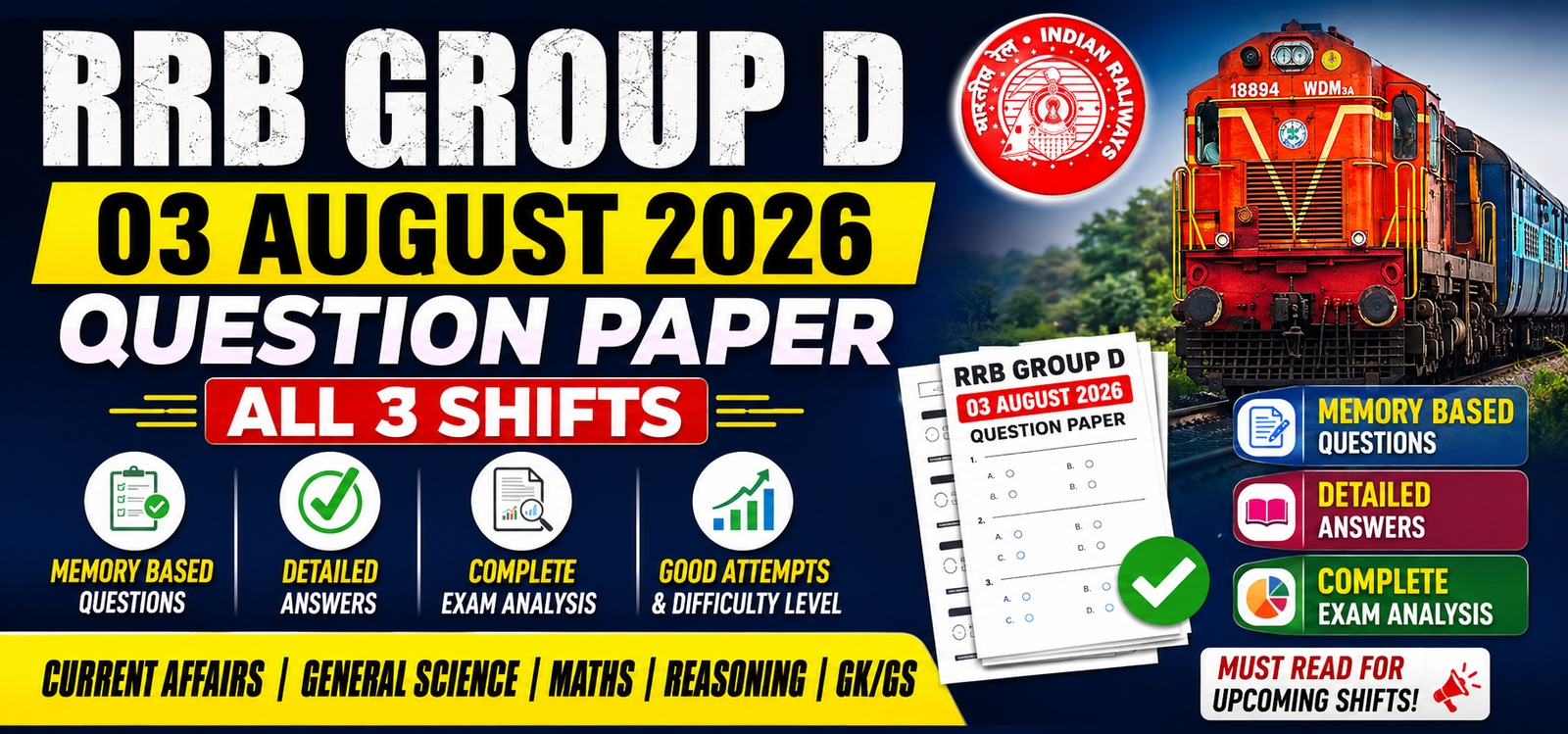
RRB Group D 03 August 2026 Question Paper (All 3 Shifts): Memory Based Questions with Answers & Complete Exam Analysis
The RRB Group D 2026 CBT Exam held on 03 August 2026 has been successfully conducted across all three shifts in different examination centres throughout the country. As soon as the exam concluded, thousands of Railway aspirants started searching for the RRB Group D 03 August 2026 Question Paper, Memory Based Questions, Exam Analysis, Difficulty Level, and Good Attempts.
To help aspirants preparing for the upcoming shifts, the expert team at XamToppr collected memory-based questions directly from students who appeared in the examination. Every question has been carefully organized subject-wise and shift-wise so that candidates can understand the latest exam trend and prepare more effectively.
This article contains:
- ✅ Shift 1 Memory Based Questions
- ✅ Shift 2 Memory Based Questions
- ✅ Shift 3 Memory Based Questions
- ✅ Complete Exam Analysis
- ✅ Subject-wise Weightage
- ✅ Difficulty Level
- ✅ Good Attempts
- ✅ Important Topics Asked
- ✅ Repeated Questions
- ✅ Upcoming Shift Prediction
If you are going to appear in the next RRB Group D shift, then this article can significantly improve your preparation because many questions follow a similar trend throughout the examination cycle.
Disclaimer
Disclaimer: The questions shared in this article are memory-based questions collected from students and verified by our expert faculty after the examination. These are not the official Railway Recruitment Board (RRB) question papers. Whenever the official answer key or question paper is released, this article will be updated accordingly.
RRB Group D 03 August 2026 Exam Overview
|
Particular |
Details |
|
Exam Name |
RRB Group D Recruitment 2026 |
|
Conducting Body |
Railway Recruitment Board (RRB) |
|
Exam Date |
03 August 2026 |
|
Exam Mode |
Computer Based Test (CBT) |
|
Number of Shifts |
3 |
|
Question Type |
Objective (MCQ) |
|
Total Questions |
100 |
|
Total Marks |
100 |
|
Negative Marking |
1/3 Mark |
|
Question Paper |
Memory Based |
|
Status |
Available Below |
RRB Group D 03 August 2026 Exam Difficulty Level
Based on feedback received from hundreds of candidates and our faculty analysis, the overall difficulty level of the examination remained Medium. Most candidates reported that the paper followed the expected RRB Group D pattern, with a balanced distribution of Current Affairs, Science, General Knowledge, Mathematics, and Reasoning.
|
Subject |
Difficulty Level |
|
Current Affairs |
Moderate |
|
General Science |
Easy to Moderate |
|
General Knowledge |
Moderate |
|
Mathematics |
Moderate |
|
Reasoning |
Easy to Moderate |
|
Overall Paper |
Medium |
Expert Opinion
Compared to previous RRB Group D examinations, the 03 August 2026 paper focused more on Current Affairs and General Science. Many direct factual questions were asked, while Science included a mix of conceptual and application-based questions. Mathematics and Reasoning remained within the expected syllabus and did not contain lengthy calculations.
Candidates who regularly practiced Previous Year Questions (PYQs) and revised NCERT-based concepts found the paper relatively manageable.
RRB Group D 03 August 2026 Good Attempts
The number of good attempts depends on accuracy. Since there is negative marking of one-third mark, candidates should avoid excessive guessing.
Expected Good Attempts
|
Performance |
Attempts |
|
Excellent |
85+ |
|
Very Good |
80–84 |
|
Good |
75–79 |
|
Safe Zone |
70–74 |
|
Average |
60–69 |
Expert Suggestion: Candidates maintaining 90% or higher accuracy with 75–80 attempts are expected to remain in a comfortable position, although the final cutoff will depend on normalization, region, and category.
Subject-wise Weightage Analysis
One of the biggest observations from all three shifts was that the Railway Recruitment Board maintained a balanced paper while giving slightly more importance to Current Affairs and General Science.
The approximate distribution of questions was as follows:
|
Subject |
Approximate Weightage |
|
Current Affairs |
40% |
|
General Science |
25% |
|
General Knowledge |
10% |
|
Mathematics |
10–12% |
|
Reasoning |
5–10% |
|
Environment & Miscellaneous GK |
5% |
This indicates that aspirants preparing for upcoming shifts should prioritize Current Affairs, Science, and Static GK, followed by Mathematics and Reasoning.
Important Topics Asked in All Three Shifts
After analyzing all memory-based questions, several topics appeared repeatedly across Shift 1, Shift 2, and Shift 3.
1. Current Affairs
Current Affairs dominated the paper. Most questions were asked from the last 8–12 months.
Major topics included:
- National Current Affairs
- International Current Affairs
- Government Schemes
- Awards & Honours
- Sports Events
- International Summits
- Important Reports
- Committees
- Budget 2026–27
- RBI Monetary Policy
- ISRO Missions
- DRDO Projects
- AI Initiatives
- International Organizations
- Books & Authors
Important Observation: Questions were direct and fact-based. Candidates who revised monthly current affairs PDFs had a clear advantage.
2. General Science
Science remained one of the highest-weighted sections.
The questions were distributed across:
Physics
- Light
- Sound
- Electricity
- Motion
- Force
- Velocity
- Lens
- Mirror
- Power
- Energy
Chemistry
- Oxidation & Reduction
- Chemical Reactions
- Conservation of Mass
- Acids & Bases
- Hydrocarbons
- Ethanol
- Molecular Mass
- Solutions
Biology
- Human Body
- Plant Tissue
- Cell
- ATP
- Respiration
- Food Chain
- Nutrition
- Neuron
- Ultrasound
- Reproductive System
Most Science questions were concept-based but straightforward, making NCERT Class 9 and 10 books highly relevant.
3. General Knowledge
The General Knowledge section included a combination of Static GK and current events.
Major areas covered were:
- Indian Constitution
- History
- Geography
- Polity
- National Parks
- International Organizations
- Books & Authors
- Awards
- Important Headquarters
- Government Initiatives
4. Mathematics
The Mathematics section was calculation-oriented but not lengthy.
Important concepts included:
- Percentage
- Power
- Current Electricity
- Basic Formula-Based Questions
- Speed
- Time
- Magnification
- Numerical Problems
Candidates who had practiced previous RRB papers could solve most questions comfortably.
5. Reasoning
The Reasoning section remained easy.
Frequently asked topics included:
- Coding-Decoding
- Blood Relation
- Direction Sense
- Ranking
- Number Series
- Classification
- Analogy
- Syllogism
No unexpected reasoning pattern was observed.
What Was the Overall Trend of the Paper?
The biggest takeaway from the 03 August 2026 examination was that RRB emphasized conceptual clarity rather than tricky questions. Instead of asking difficult numerical problems, the board focused on direct factual knowledge, NCERT-based science concepts, current affairs, and basic reasoning.
Candidates who maintained regular current affairs preparation, revised NCERT science, and solved previous year papers found the exam balanced. On the other hand, aspirants who relied only on short notes or guesswork found the Current Affairs section comparatively challenging because many questions were based on recent national and international developments.
Another important observation was the repetition of themes related to ISRO, DRDO, Budget 2026–27, Sports Awards, Government Schemes, Biology, Physics formulas, and Constitutional topics. This clearly indicates that Railway is continuing its trend of combining current affairs with conceptual General Science.
Shift-wise Memory Based Questions
In the next section of this article, we have provided the complete Shift 1 and Shift 2 memory-based questions with answers, exactly as collected from students after the examination. Each question has been arranged systematically to help aspirants revise quickly and identify the most important topics for upcoming shifts.
Shift 1 Memory Based Questions with Answers (03 August 2026)
The RRB Group D 03 August 2026 Shift 1 paper was conducted in the morning session across various examination centres. According to the feedback received from candidates, the overall difficulty level of the paper was Easy to Moderate, with Current Affairs and General Science carrying the highest weightage.
A large number of questions were directly based on recent current affairs, while the Science section included questions from Physics, Chemistry, and Biology based on NCERT concepts. Mathematics and Reasoning remained within the expected syllabus and did not introduce any new pattern.
Below are the memory-based questions collected by the XamToppr Expert Team after verification.
RRB Group D 03 August 2026 Shift 1 Memory Based Questions
Q1. In April 2025, the Sachet App was launched by which organization?
Answer: C-DOT in collaboration with NDMA.
Q2. Dr. N. Rajam, who received the Padma Vibhushan 2026, is associated with which musical instrument?
Answer: Violin.
Q3. What is the name of actor Vijay Thalapathy's political party?
Answer: Tamilaga Vettri Kazhagam (TVK).
Q4. Where was the bilateral summit between Prime Minister Narendra Modi and French President Emmanuel Macron held in February 2026?
Answer: Mumbai.
Q5. Which Indian athlete won the gold medal in the Men's Long Jump at the Indian Athletics Series 2026?
Answer: Murali Sreeshankar.
Q6. Who won the Laureus World Sports Awards 2026 (Sportsman of the Year)?
Answer: Carlos Alcaraz.
Q7. Which city will host the Ballon d'Or ceremony for the first time outside Paris in 2026?
Answer: London.
Q8. Which state government launched the "Aaroh 2026" Summer Sports Camp?
Answer: Madhya Pradesh.
Q9. Which meeting of the RBI Monetary Policy Committee was held from 6–8 April 2026?
Answer: 60th Meeting.
Q10. What is the current Repo Rate after the RBI policy of December 2025?
Answer: 5.25%.
Q11. What is the name of ISRO's heaviest communication satellite launched on 2 November 2025?
Answer: CMS-03 (GSAT-7R).
Q12. Which Indian state was affected across 26 districts by storms, rainfall and lightning during May 2026?
Answer: Uttar Pradesh.
Q13. According to the World Bank, what was India's extreme poverty rate in 2022–23?
Answer: 5.3%.
Q14. Which organization initiated Project Sur for India's Next Generation Launch Vehicle (NGLV)?
Answer: ISRO.
Q15. Cyber slavery and digital arrest fraud networks mainly operate in which region?
Answer: Southeast Asia (Golden Triangle Region).
Q16. Which Indian film became India's official entry to the 98th Academy Awards?
Answer: Home Bound.
Q17. Which important strategic strait was closed by Iran during the 2026 conflict?
Answer: Strait of Hormuz.
Q18. A question related to the European Union was asked.
Answer: European Union.
Q19. If kinetic energy increases from 40 J to 140 J, calculate the work done.
Answer: 100 Joules.
Q20. A bulb has a power rating of 60 W and operates at 120 V. Find the current.
Answer: 0.5 Ampere.
Q21. What is the formula of frequency?
Answer:
f = v / λ
Q22. A light wave has a wavelength of 600 nm and travels at 3 × 10⁸ m/s. Find its frequency.
Answer: 5 × 10¹⁴ Hz.
Q23. If 20 grams of salt is dissolved in 80 grams of water, calculate the mass percentage concentration.
Answer: 20%.
Q24. Which part of the neuron receives impulses?
Answer: Dendrite.
Q25. Why does the sky appear blue?
Answer: Due to scattering of sunlight.
Q26. In which medium does sound travel the fastest?
Answer: Solid.
Q27. What is the process of obtaining energy from glucose known as?
Answer: Cellular Respiration.
Q28. Who is the primary consumer in a food chain?
Answer: Herbivores.
Q29. Why is ethanol widely used in medicines?
Answer: Because it acts as an excellent solvent.
Q30. Who proposed the Law of Conservation of Mass?
Answer: Antoine Lavoisier.
Q31. What are the products formed when NaOH reacts with HCl?
Answer: Sodium Chloride (NaCl) and Water (H₂O).
Q32. What is the primary function of Parenchyma tissue?
Answer: Food storage, support, and flexibility.
Q33. What is the formula for magnification of a lens?
Answer:
m = v / u
Q34. State Newton's Second Law of Motion.
Answer:
F = ma
Q35. What is the formula of relative refractive index?
Answer:
v₁ / v₂
Q36. Which of the following are decomposition reactions?
- AgBr in sunlight
- Heating CaCO₃
- Electrolysis of Water
- Fe + CuSO₄
Answer: 1, 2 and 3 only.
Q37. Why is the cell membrane flexible?
Answer: Because it is made of a lipid-protein bilayer.
Q38. What does the slope of a displacement-time graph represent?
Answer: Velocity.
Q39. What does an inclined velocity-time graph indicate?
Answer: Changing velocity (Acceleration or Deceleration).
Q40. Where is ultrasound commonly used?
Answer: Medical imaging and detection of cracks in metals.
Q41. What is the primary function of vocal cords?
Answer: Production of sound.
Q42. What is Molecular Mass?
Answer: The sum of the atomic masses of all atoms present in a molecule.
Q43. What are Intercellular Spaces?
Answer: The spaces present between adjacent plant cells that help in gaseous exchange and transport.
Shift 1 Exam Analysis (Expert Review)
The first shift of RRB Group D 03 August 2026 clearly indicated that the Railway Recruitment Board is continuing its trend of asking concept-based General Science along with recent Current Affairs. Instead of difficult numerical problems, the exam emphasized factual knowledge, NCERT fundamentals, and current national as well as international events.
The Current Affairs section included questions from government schemes, sports, RBI policy, international relations, ISRO missions, awards, and important reports. Candidates who had regularly revised the last 8–10 months of current affairs found this section relatively straightforward.
In General Science, questions were evenly distributed among Physics, Chemistry, and Biology. Physics focused on formulas and basic concepts such as frequency, velocity, work, electricity, refraction, sound, and Newton's laws. Chemistry covered chemical reactions, conservation of mass, solutions, ethanol, and molecular mass, while Biology asked questions from cell structure, plant tissues, neurons, respiration, and food chains.
Overall, Shift 1 followed the expected RRB pattern and rewarded candidates with strong conceptual understanding rather than rote memorization.
Important Topics Asked in Shift 1
Current Affairs
- RBI Monetary Policy
- Repo Rate
- ISRO
- Sports Awards
- Ballon d'Or
- Government Schemes
- World Bank Report
- International Relations
- Academy Awards
- Padma Awards
Physics
- Work & Energy
- Frequency
- Electricity
- Current
- Lens Formula
- Refraction
- Sound
- Motion
- Newton's Laws
Chemistry
- Conservation of Mass
- Acids & Bases
- Chemical Reactions
- Ethanol
- Molecular Mass
- Solution Concentration
Biology
- Neuron
- Cell Membrane
- Respiration
- Plant Tissue
- Food Chain
- Vocal Cords
- Ultrasound
- Intercellular Spaces
Key Takeaways from Shift 1
- Current Affairs dominated the paper, contributing nearly 40% of the General Awareness section.
- General Science remained highly scoring, especially for candidates with strong NCERT fundamentals.
- Formula-based Physics questions were direct and required conceptual clarity.
- Biology featured several questions from plant tissues, cell biology, and human physiology.
- Mathematics and Reasoning followed the expected RRB Group D pattern without introducing surprise topics.
Expert Tip: If your exam is scheduled in the upcoming shifts, prioritize revising Current Affairs (last 8–10 months), NCERT Science (Classes 9–10), important Physics formulas, and Biology concepts, as these topics showed the highest frequency in Shift 1.
Shift 2 Memory Based Questions with Answers (03 August 2026)
The RRB Group D 03 August 2026 Shift 2 examination was conducted in the afternoon session. According to the feedback collected from candidates across multiple examination centres, the overall difficulty level of the paper remained Easy to Moderate, similar to Shift 1.
However, Shift 2 showed a slightly stronger focus on Current Affairs, Government Schemes, Sports, General Science, and Biology. Most questions were direct and fact-based, while Physics and Chemistry continued to test fundamental concepts rather than lengthy numerical calculations.
Below are the verified memory-based questions collected by the XamToppr Expert Team.
RRB Group D 03 August 2026 Shift 2 Memory Based Questions
Q1. Which IIT launched the "Param Shakti" supercomputer with a computing capacity of 3.1 Petaflops in January 2026?
Answer: IIT Madras.
Q2. Which two disasters were recommended by the 16th Finance Commission to be included in the list of National Disasters?
Answer: Heatwaves (Loo) and Lightning Strikes.
Q3. Who won the Laureus World Sports Award 2026 in the Sportswoman of the Year category?
Answer: Aryna Sabalenka.
Q4. Which Governor of West Bengal resigned on 5 March 2026?
Answer: Dr. C. V. Ananda Bose.
Q5. Which district of Manipur was affected by the major earthquake in 2026?
Answer: Kamjong District.
Q6. Which district of Manipur was severely affected by flash floods due to heavy rainfall?
Answer: Churachandpur District.
Q7. On which date is the birth anniversary of Dr. B. R. Ambedkar celebrated?
Answer: 14 April.
Q8. The West Bengal Government launched the Annapurna Scheme for whose welfare?
Answer: Women.
Q9. Who is the author of the book "Apnapan" based on Prime Minister Narendra Modi?
Answer: Shivraj Singh Chouhan.
Q10. Who released the book "Apnapan"?
Answer: M. Venkaiah Naidu and H. D. Deve Gowda.
Q11. From where was ISRO's PSLV-C62 mission launched?
Answer: Satish Dhawan Space Centre, Sriharikota.
Q12. Which Indian sprinter created a National Record by completing the men's 100 metres race in 10.09 seconds?
Answer: Gurvinder Singh.
Q13. Where was the 6th India–UK Ministry of Home Affairs Dialogue held?
Answer: New Delhi.
Q14. What was the objective of Punjab Government's Operation Prahar?
Answer: To eliminate gangster networks and organized crime.
Q15. Which country hosted the AFCON 2025–26 tournament?
Answer: Morocco.
Q16. Which state hosted the Khelo India Tribal Games 2026?
Answer: Chhattisgarh.
Q17. Which edition of the Central Council of Health and Family Welfare Conference was held in June 2026?
Answer: 16th Edition.
Q18. Which AI-powered chatbot was launched by the Income Tax Department?
Answer: Saarthi App.
Q19. Which sector contributes the highest share to India's Gross Value Added (GVA)?
Answer: Service (Tertiary) Sector.
Q20. Which franchise won IPL 2026?
Answer: Royal Challengers Bengaluru (RCB).
Q21. Where is the Intercalary Meristem found?
Answer: At the base of leaves and near the internodes.
Q22. Which tissue is absent in plants?
Answer: Nervous Tissue.
Q23. Arrange the correct sequence of the Water Cycle.
Answer: Evaporation → Condensation → Precipitation → Collection.
Q24. An object is placed 18 cm in front of a convex lens having a focal length of 12 cm. Find the magnification.
Answer: -2.
Q25. If the potential difference remains constant and resistance becomes double, what happens to the heating effect?
Answer: It becomes half.
Q26. During which trimester does an embryo develop into a fetus?
Answer: First Trimester.
Q27. What are the products formed when ethanol burns in sufficient oxygen?
Answer: Carbon dioxide, Water, Heat and Light.
Q28. According to the Law of Conservation of Mass, what remains constant during a chemical reaction?
Answer: Total mass of reactants equals the total mass of products.
Q29. An atom has atomic number 17. Find the number of protons, electrons and its valency.
Answer: 17 Protons, 17 Electrons, Valency = 1.
Q30. How many neutrons are present in a neutral Chlorine atom?
Answer: 18.
Q31. A bottle opener is an example of which class of lever?
Answer: Second-Class Lever.
Q32. Which kingdom includes all prokaryotic organisms?
Answer: Monera.
Q33. Which hydrocarbon possesses a cyclic ring structure?
Answer: Cyclohexane.
Q34. What does the area under a Velocity-Time graph represent?
Answer: Displacement.
Q35. Which instrument is used to detect underwater objects?
Answer: SONAR.
Q36. If the mass of an object becomes half while the applied force remains constant, what happens to acceleration?
Answer: Acceleration becomes double.
Q37. If resistance is reduced to half while voltage remains constant, what happens to current?
Answer: Current becomes double.
Q38. Which plant tissue is present in coconut husk?
Answer: Sclerenchyma.
Q39. What similarity exists between Plastids and Mitochondria?
Answer: Both contain their own DNA and 70S Ribosomes.
Q40. Which part of the brain controls body balance?
Answer: Cerebellum.
Q41. Which organ primarily removes waste products from the human body?
Answer: Kidneys.
Q42. What is the primary function of Parenchyma Tissue?
Answer: Storage of food and support in plants.
Shift 2 Exam Analysis (Expert Review)
The Second Shift followed almost the same pattern as Shift 1, but there was a noticeable increase in the number of questions related to Government Schemes, Sports Events, International Affairs, and Biology.
One of the major highlights was the continued importance of Current Affairs, with questions from Finance Commission recommendations, ISRO missions, IPL 2026, AI initiatives, Government Operations, and international sports events. This confirms that candidates appearing in future shifts should revise at least the last 8–10 months of Current Affairs thoroughly.
The Science section once again focused on NCERT-based concepts rather than difficult calculations. Biology contributed a significant number of questions from plant tissues, human reproduction, classification, nervous system, and cell biology, while Physics covered topics such as lenses, electricity, graphs, motion, and force. Chemistry questions were mostly from basic reactions, hydrocarbons, and atomic structure.
Overall, candidates who had practiced Previous Year Questions (PYQs) and revised Class 9–10 NCERT Science found the paper straightforward.
Shift 1 vs Shift 2 Comparison
|
Topic |
Shift 1 |
Shift 2 |
|
Current Affairs |
★★★★★ |
★★★★★ |
|
General Science |
★★★★★ |
★★★★★ |
|
Physics |
Moderate |
Moderate |
|
Chemistry |
Easy |
Easy |
|
Biology |
Moderate |
Slightly Higher |
|
Mathematics |
Moderate |
Moderate |
|
Reasoning |
Easy |
Easy |
|
Overall Difficulty |
Medium |
Medium |
Major Observation
- Both shifts gave the highest priority to Current Affairs.
- Biology had slightly higher representation in Shift 2.
- Physics questions were mostly formula and concept based.
- No unexpected pattern or high-level numerical questions were asked.
- Candidates with strong NCERT fundamentals could score well.
Most Repeated Topics (Shift 1 + Shift 2)
After comparing both shifts, several topics appeared repeatedly. These are highly important for candidates whose exams are scheduled in the coming days.
Current Affairs
- ISRO Missions
- Government Schemes
- RBI & Economy
- Awards & Honours
- Sports Events
- Books & Authors
- International Summits
- AI & Technology
- Budget 2026
- National Reports
Physics
- Electricity
- Lens
- Motion
- Force
- Velocity-Time Graph
- Current
- Heating Effect
- Work & Energy
- Sound
- SONAR
Chemistry
- Conservation of Mass
- Chemical Reactions
- Hydrocarbons
- Ethanol
- Atomic Structure
- Molecular Mass
- Acids & Bases
Biology
- Plant Tissues
- Human Reproduction
- Cell Biology
- Nervous System
- Respiration
- Brain
- Classification
- Mitochondria
- Plastids
Expert Prediction for Upcoming Shifts
Based on the analysis of both shifts, candidates appearing in the remaining RRB Group D examinations should focus on the following high-priority areas:
- Current Affairs (Last 8–10 Months) – Awards, Sports, Budget, Government Schemes, Reports, ISRO, DRDO, RBI, International Relations.
- General Science – NCERT Class 9 & 10 Physics, Chemistry, and Biology.
- Physics – Electricity, Motion, Light, Sound, Lens, Mirror, Work, Energy, Graphs.
- Chemistry – Chemical Reactions, Periodic Table, Hydrocarbons, Acids & Bases, Atomic Structure.
- Biology – Cell, Tissues, Human Body, Nutrition, Respiration, Plant Physiology, Reproduction.
- Static GK – Constitution, Geography, History, Important Days, Organizations, Books & Authors.
Key Takeaways from Shift 2
- Current Affairs remained the highest-scoring and highest-weightage section.
- Biology gained slightly more importance compared to Shift 1.
- Science questions continued to be concept-based rather than calculation-heavy.
- Most questions could be solved with a solid understanding of NCERT Class 9–10 and regular current affairs revision.
- The overall paper pattern remained stable, making previous year papers one of the best resources for preparation.
Expert Tip: If your RRB Group D exam is yet to be conducted, revise Current Affairs, General Science, and Static GK thoroughly. The repetition of themes across both shifts suggests that similar topics may continue to appear in the remaining examination sessions.
RRB Group D 03 August 2026 Shift 3 Memory Based Questions with Answers
The RRB Group D 03 August 2026 Shift 3 examination maintained almost the same difficulty level as the first two shifts. However, this shift included comparatively more questions from Budget 2026–27, Indian Constitution, Physics, Chemistry, Biology, and Defence-related Current Affairs.
One of the most noticeable observations was that many Science questions were directly based on NCERT Class 9 & 10, while Current Affairs focused on recent national and international events.
Below are the verified memory-based questions collected from candidates.
RRB Group D 03 August 2026 Shift 3 Memory Based Questions
Q1. Which birth anniversary of Rabindranath Tagore was celebrated in 2026?
Answer: 165th Birth Anniversary.
Q2. Where was the India AI Impact Summit (Global AI Summit) held?
Answer: Bharat Mandapam, New Delhi.
Q3. Which meristematic tissue is responsible for secondary growth in dicot plants?
Answer: Lateral Meristem (Cambium).
Q4. Which statement is correct regarding the organizational structure of BCCI?
Answer: BCCI is governed by its office bearers and a 9-member Apex Council.
Q5. Which ministry controls DRDO?
Answer: Ministry of Defence.
Q6. What is the objective of joint exercises conducted by the Indian Navy and Indian Air Force?
Answer: To strengthen coastal security and improve operational coordination.
Q7. Which civilian honour is the Padma Shri Award?
Answer: India's Fourth Highest Civilian Award.
Q8. Which missile systems were recently developed by DRDO?
Answer: Agni-P, Pralay and Prahar.
Q9. Differentiate between Oxidation and Reduction.
Answer:
- Oxidation → Loss of electrons / Addition of Oxygen
- Reduction → Gain of electrons / Removal of Oxygen
Q10. Under which Article of the Constitution is the Union Budget presented?
Answer: Article 112.
Q11. Balancing of chemical equations is based on which law?
Answer: Law of Conservation of Mass.
Q12. How is Molecular Mass calculated?
Answer: Sum of the atomic masses of all atoms present in a molecule.
Q13. Why does Benzene mainly undergo substitution reactions?
Answer: Due to resonance stability.
Q14. State the relation between Power and Energy.
Answer:
Power = Energy ÷ Time
Q15. Write the formula of Gravitational Potential Energy.
Answer:
PE = mgh
Q16. Which of the following is NOT a part of the male reproductive system?
Answer: Fallopian Tube.
Q17. What is the process of coating iron with zinc called?
Answer: Galvanization.
Q18. In which form is energy stored inside living cells?
Answer: ATP.
Q19. What type of image is formed when an object is placed between the pole and focus of a concave mirror?
Answer: Virtual, Erect and Magnified.
Q20. Calculate the molecular masses of H₂O and CH₃COOH.
Answer: 18 u and 60 u.
Q21. Why is vinegar used as a food preservative?
Answer: It inhibits the growth of microorganisms.
Q22. In the reaction
2Cu + O₂ → 2CuO
Which substance is oxidized?
Answer: Copper.
Q23. A 2000 W heater runs for one hour. Calculate the electrical energy consumed.
Answer: 7.2 × 10⁶ Joules.
Q24. Which plant tissue provides flexibility?
Answer: Collenchyma.
Q25. Why does a swimming pool appear shallower?
Answer: Due to Refraction of Light.
Q26. What happens to the refractive index when light travels from water to air?
Answer: It decreases.
Q27. NIMHANS-2 announced in Budget 2026–27 is related to which sector?
Answer: Healthcare and Mental Health.
Q28. What percentage of the Union Budget 2026–27 was allocated as Gender Budget?
Answer: 9.37%.
Q29. What is the electric charge of a neutron?
Answer: Neutral.
Q30. Why does a pencil immersed in water appear bent?
Answer: Due to Refraction of Light.
Q31. Why does a coin placed inside water appear raised?
Answer: Due to Refraction of Light.
Complete Analysis of All Three Shifts
After analyzing more than 115 memory-based questions collected from all three shifts, several important trends have emerged. Candidates appearing in upcoming RRB Group D examinations should pay special attention to these observations.
Overall Difficulty Level
|
Shift |
Difficulty |
|
Shift 1 |
Easy to Moderate |
|
Shift 2 |
Easy to Moderate |
|
Shift 3 |
Moderate |
|
Overall |
Easy to Moderate |
The examination was balanced and did not include any unexpected high-level questions. Candidates with good preparation in NCERT Science, Current Affairs, and Previous Year Questions could comfortably attempt a high number of questions.
Subject-wise Trend
|
Subject |
Weightage |
|
Current Affairs |
★★★★★ |
|
General Science |
★★★★★ |
|
Static GK |
★★★★☆ |
|
Mathematics |
★★★☆☆ |
|
Reasoning |
★★★☆☆ |
The highest priority was clearly given to Current Affairs and General Science.
Most Repeated Topics in All Three Shifts
Current Affairs
- Budget 2026–27
- RBI Monetary Policy
- Repo Rate
- ISRO Missions
- DRDO
- Government Schemes
- AI Initiatives
- Sports Awards
- Books & Authors
- International Summits
- IPL 2026
- Ballon d'Or
- Laureus Awards
Physics
- Electricity
- Current
- Power
- Energy
- Motion
- Lens
- Mirror
- Refraction
- Sound
- Velocity-Time Graph
- Newton's Laws
Chemistry
- Chemical Reactions
- Oxidation
- Reduction
- Conservation of Mass
- Molecular Mass
- Hydrocarbons
- Acids and Bases
- Ethanol
Biology
- Plant Tissue
- Human Body
- ATP
- Respiration
- Cell
- Neuron
- Brain
- Reproductive System
- Classification
- Nutrition
Expected Questions for Upcoming Shifts
Based on the trend of all three shifts, candidates should revise the following topics on priority:
Current Affairs
- Government Schemes
- Budget Highlights
- Sports Events
- Awards
- ISRO
- DRDO
- RBI
- International Organizations
- Reports & Indexes
- AI Developments
Science
Physics
- Electricity
- Lens
- Mirror
- Motion
- Sound
- Work
- Energy
Chemistry
- Periodic Table
- Chemical Reaction
- Hydrocarbon
- Carbon Compounds
- Acids & Bases
Biology
- Human Body
- Cell
- Tissue
- Nutrition
- Disease
- Reproduction
- Plant Physiology
Preparation Strategy for Upcoming Candidates
If your RRB Group D exam is still pending, focus on the following:
- Revise the last 8–10 months of Current Affairs thoroughly.
- Read NCERT Science (Class 9 & 10) at least once.
- Practice RRB Group D Previous Year Papers regularly.
- Memorize important Physics formulas.
- Revise important Biology diagrams and concepts.
- Solve daily mock tests to improve speed and accuracy.
- Avoid blind guessing because of 1/3 negative marking.
Frequently Asked Questions (FAQs)
Q1. What was the overall difficulty level of the RRB Group D 03 August 2026 exam?
Answer: The overall difficulty level of all three shifts was Easy to Moderate.
Q2. Which subject carried the highest weightage?
Answer: Current Affairs and General Science.
Q3. How many questions were asked in the RRB Group D CBT exam?
Answer: 100 Questions.
Q4. Was there negative marking?
Answer: Yes, one-third mark was deducted for every incorrect answer.
Q5. Were the questions memory-based?
Answer: Yes. The questions in this article are memory-based and collected from candidates after the examination.
Q6. Which topics were repeated in all three shifts?
Answer: Current Affairs, ISRO, DRDO, Budget 2026, Biology, Physics formulas, Chemical Reactions, and Government Schemes.
Q7. Which Science book is best for RRB Group D preparation?
Answer: NCERT Class 9 & 10 Science.
Q8. Were Current Affairs difficult?
Answer: No. Most questions were direct and fact-based.
Q9. Is this the official RRB question paper?
Answer: No. This is a verified memory-based paper compiled from student feedback.
Q10. Can similar questions be expected in upcoming shifts?
Answer: Yes. Based on previous RRB trends, similar topics are often repeated across shifts.
Conclusion
The RRB Group D 03 August 2026 Question Paper (All 3 Shifts) indicates that the Railway Recruitment Board continues to focus on Current Affairs, General Science, and basic conceptual understanding. Candidates who regularly revised NCERT books, practiced previous year papers, and stayed updated with current affairs found the paper manageable.
This memory-based compilation has been prepared after collecting questions from candidates who appeared in all three shifts and organizing them topic-wise for easy revision. Aspirants appearing in the upcoming shifts should use this analysis to identify high-priority topics, strengthen weak areas, and revise the most frequently asked concepts before their exam.
Download Memory-Based PDF
RRB Group D 4 August 2026 Question Paper (All 3 Shifts)
Coverage : All 3 Shifts
RRB Group D 03 August 2026 Question Paper (All 3 Shifts)
Coverage : All 3 Shifts
Join XamToppr for Daily Updates
Stay connected with XamToppr to get:
- Latest RRB Group D Memory-Based Papers
- Daily Current Affairs PDFs
- Previous Year Question Papers
- Free Mock Tests
- Exam Analysis
- Practice Sets
- Biology, Physics & Chemistry Notes
- SSC, Railway, BPSC & State Exam Updates
Suggested Internal Links
To improve your preparation, you can also explore:
Railway Group D Practice Set PDF 2026: TCS PYQs
Coverage : 15 Mock Test & 15 PYP
Railway Group D 2025 Previous Year Question Papers
Coverage : All 101 Shifts
RRB Group D Current Affairs and GK E-Book PDF 2026
Coverage : 101 Shifts & 2020 Questions Chapter Wise (English & Hindi)
RRB Group D Complete Science E-Book PDF 2026
Coverage : 101 Shifts, 2525 Questions Chapter Wise (English & Hindi)
RRB Group D GS & GA Chapter Wise Solved Papers PDF
Coverage : 23400 Questions
RRB Group D General Science & GK Chapterwise Solved Papers PDF 2026
Coverage : 234 Sets, Hindi Medium
RRB General Knowledge Chapterwise Solved Papers HINDI Medium
Coverage : 15210+ Questions

About XamToppr
XamToppr is an educational platform dedicated to helping aspirants prepare for Railway, SSC, Banking, Defence, BPSC, UPSC, and State Government examinations. Our expert team publishes memory-based papers, current affairs, practice sets, mock tests, exam analysis, and study materials designed according to the latest exam pattern. Every article is reviewed to provide accurate, useful, and exam-oriented content, helping students prepare more effectively and confidently.